AI Compliance Reviewer
AI Compliance Reviewer for Pull Requests in Regulated Software
Shift compliance left by reviewing every pull request against your own standards, requirements, and audit evidence.
AI Compliance Reviewer for Regulated Software
KomAInu Compliance Reviewer is an AI code review tool for regulated software teams. It reviews every GitHub pull request against your own standards, requirements, compliance documents, security policies, and SRS documents, then links each finding to the relevant requirement, source passage, commit, file, and audit decision.
Instead of acting like a generic AI code reviewer, KomAInu grounds every finding in the exact requirement and source passage it violates. Each issue becomes audit-ready traceability evidence connected to the pull request, commit, file, suggested fix, and final team decision.
It is designed for teams working with ISO 27001, FHIR, DO-178C, ISO 26262, EN 50128, IEC 62304, defense standards, internal SRS documents, and requirements-based testing processes.
What Is an AI Compliance Reviewer?
An AI compliance reviewer is an automated compliance review system that checks software changes against the requirements, standards, and audit obligations a team must satisfy before code is merged.
For pull request compliance, the reviewer must do more than find common bugs. It needs to understand the governing requirement, identify whether the code change violates it, cite the source passage, and preserve requirements traceability so auditors can follow the evidence from code to requirement to decision.
What Is the KomAInu Compliance Reviewer?
The KomAInu Compliance Reviewer connects to your GitHub repository and inspects every pull request for compliance gaps and security-relevant issues, grounded in your standards, not a generic rulebook.
You upload the documents that define correct for your team: ISO 27001, FHIR specifications, safety norms, an SRS, coding standards, or internal business documentation. KomAInu extracts the requirements from them. From that point on, every PR is reviewed against those requirements, and every finding is recorded in a full audit trail: the pull request, the commit, the file, the requirements it violated, and what you decided to do about it.
- A continuous alerting layer that makes PR review faster and safer, catching what tired human reviewers miss in a 1,500-line diff.
- A self-building compliance record so audits and certifications become a byproduct of normal work instead of a fire drill.
It is agnostic by design: any codebase, any compliance framework you upload. The demo runs on a healthcare repository, but the mechanics are identical for aerospace, automotive, railway, defense, or any team that has to prove what it built.
Who Is the Compliance Reviewer For?
KomAInu is built for software teams that need to prove compliance, traceability, and verification coverage across code changes.
- V&V and IVVQ teams that need evidence from requirements-based testing and software verification work.
- QA and software quality teams that want automated compliance review inside normal engineering workflows.
- Safety-critical software teams building regulated software where a missed requirement can become release, certification, or audit risk.
- Aerospace and defense software teams working with DO-178C-related process documents, SRS rules, and internal verification standards.
- Medical device, healthcare, automotive, and railway teams working with IEC 62304, FHIR, ISO 26262, EN 50128, or internal compliance standards.
The Problem: Compliance Lives Outside the Pull Request
Most engineering teams already do code review. What they do not have is a link between that review and the standards they are accountable to. That gap creates three recurring failures.
- Reviewers cannot hold the whole rulebook in their head while cross-referencing ISO 27001 and a FHIR spec line by line.
- Findings get lost the moment the PR is merged, because comments are resolved and institutional memory disappears.
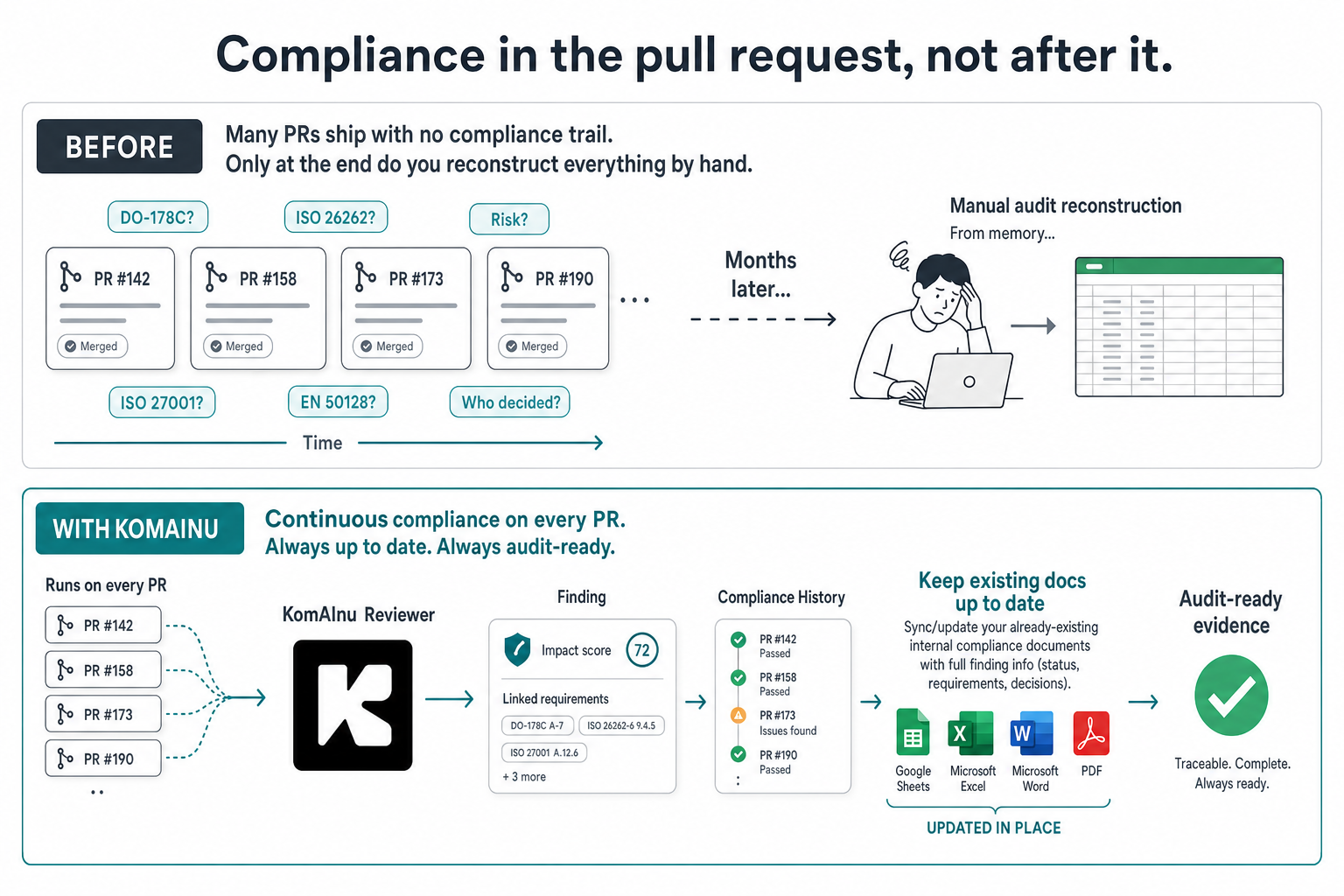
- The audit trail is assembled by hand, too late, from memory, Git history, spreadsheets, and collapsed review threads.
Generic AI review bots do not fix this. They lint for smells and common CWEs, but they do not know your requirements, they do not manage pull request compliance, and they do not produce an audit trail.
How It Works, End to End
1. Connect your repository
Sign in, install the GitHub app, and select the repositories you want KomAInu to work on. The selected repo appears in the Reviewer app; select it again to confirm, and you are connected.
2. Give it your compliance context
Drag and drop the documents that define compliance for your project. In the demo, on the HealthChain repository, that includes ISO 27001 and FHIR specifications. It can also be any norm, spec, requirements document, or business documentation that gives the reviewer the right context.
KomAInu extracts the requirements from those documents and lists them in a Requirements tab, where you can review and adjust them. Findings are anchored to your rules, and they cite the exact passage of the document that applies.
3. Every pull request gets reviewed, grouped by the real issue
To stress-test the reviewer, we opened a deliberately difficult pull request: 23 commits, roughly 1,500 lines changed, with 10 compliance-related vulnerabilities hidden inside, each tied to a compliance requirement. About two minutes later, the automated compliance review was done.
- KomAInu groups by the real issue in the code instead of spamming one finding per requirement.
- Each vulnerability has an impact score that tells reviewers how serious it is.
- Underneath each vulnerability sit the compliance requirements it breaks, with the exact document passage that applies.
- Below that, GitHub suggestions appear on the real lines, so the fix can be reviewed and applied in one click.
One card per problem. Impact score on top. Requirements and source passages underneath. A concrete one-click fix suggestion at the bottom.
KomAInu vs GitHub Copilot Benchmark
KomAInu found every planted vulnerability and grounded each finding in the requirements it violated. GitHub Copilot delivered solid general-purpose review, but missed compliance-relevant issues that only make sense when the reviewer understands your standards.
Read the Copilot benchmark results →A Continuous Alerting System, Not a One-Time Gate
The reviewer runs on every pull request, which turns it into a continuous alerting system for compliance and security, the same way CI continuously alerts you about broken tests.
Instead of scheduling a heavyweight compliance pass before a release, you get a lightweight, requirement-aware second opinion on every change, while the context is still fresh and the author is still around. Pull request compliance problems are caught when they are cheap to fix, in the PR, not after they have shipped and hardened into technical and regulatory debt.
For reviewers, it is a force multiplier: the AI handles the exhaustive cross-referencing against the rulebook, and humans spend their attention on judgment calls.
KomAInu vs Generic AI Code Reviewers
Generic AI code reviewers detect common bugs, style issues, and security patterns. KomAInu reviews pull requests against the standards and requirements your team is actually accountable to.
Generic AI code reviewers usually answer: Is this code suspicious? KomAInu answers: Does this code violate a specific requirement, standard, or audit obligation, and where is the evidence?
| Generic AI code reviewer | KomAInu Compliance Reviewer |
|---|---|
| Checks code quality and common security issues. | Checks code against uploaded compliance documents. |
| Produces comments that live only in the PR. | Produces traceable audit evidence: each finding linked to PR, commit, file, requirement, and decision. |
| May miss domain-specific obligations. | Grounds findings in standards, SRS, norms, and internal rules. |
| No lasting compliance record. Comments disappear after merge. | Builds a Compliance History automatically as PRs are reviewed and merged. |
| Leaves your Sheets, Excel, Word, or PDF audit docs out of date. | Syncs findings back into your existing compliance documents in one click, updated in place. |
That difference matters for teams searching for an AI code review audit trail, software compliance automation, automated compliance review for regulated software, or an AI tool for requirements traceability.
Compliance History: Your Audit Trail Builds Itself
Every finding KomAInu detects is recorded in your Compliance History, linked to the exact pull request, commit, file, and requirements it violated. It uses the same clean structure as the PR view: one card per vulnerability, with all associated requirements underneath. The audit trail builds while engineers review and merge code.
From there, you can sync your internal compliance documents in one click. The demo uses a Google Sheet, but it works with Excel, Word, or whatever format your team already lives in. Unique vulnerabilities land as rows, with columns already filled in.
- Frameworks
- Requirement references
- Impact
- Suggested treatment
- Status and decision history
The result is full requirements traceability: from a line of code, to the requirement it breaks, to the document that requirement comes from, to the decision your team made.
Closing the loop
- Apply KomAInu's suggested changes in the pull request.
- Return to the History tab and mark the vulnerability as Resolved.
- Sync, and the status is reflected directly in your sheet.
- If you start from an empty spreadsheet, KomAInu fills it with findings.
- If you already have internal documents, it will not override them automatically. It gives you suggestions to validate, and adapts new vulnerabilities to your existing format.
- When you mark something a False Positive, that feedback teaches the reviewer your context, so it stops flagging the same pattern on future reviews.
Why Pull Request Compliance Matters
Regulated software teams are expected to maintain traceability between requirements, implementation, verification activities, risk controls, and audit evidence. Standards such as DO-178C, ISO 26262, IEC 62304, EN 50128, ISO 27001, and healthcare interoperability specifications like FHIR all require teams to demonstrate control over software changes, risks, requirements, and verification evidence.
KomAInu brings that evidence collection closer to the actual engineering workflow: the pull request. This makes software compliance automation continuous instead of retrospective.
- Shift compliance left by moving the compliance check from a late, manual audit into a continuous, automated step on every pull request.
- Make PR review faster and more reliable with a requirement-aware second reviewer that never gets tired on a 1,500-line diff.
- Make audit evidence a byproduct with a living traceability record: code to requirement to document to decision.
Supported Standards and Frameworks
KomAInu can review pull requests against any standard or internal document you upload, including ISO 27001, FHIR, DO-178C, ISO 26262, EN 50128, IEC 62304, SRS documents, cybersecurity policies, coding standards, and internal compliance procedures.
- Agnostic to your framework and stack. Upload ISO 27001, FHIR, DO-178C, ISO 26262, EN 50128, IEC 62304, or your own internal standard.
- Your data stays yours. KomAInu is model-agnostic and can run on-premise or with a private model, so your documents, requirements, and code never have to leave your infrastructure.
- Grounded, not generic. Every finding cites the specific requirement and document passage it violates.
Watch the Full Demo
See the entire flow: setup, review, the Copilot comparison, and Compliance History syncing to a Google Sheet.
Where This Fits in the KomAInu Platform
The Compliance Reviewer is the shift-left front door to the same traceability engine that powers the rest of KomAInu.
AI Requirements Traceability Matrix →Test Coverage Gap Analysis →IVVQ and Software Verification →AI Test Case Generation →QA Testing Software →Compliance in the PR, coverage across the SRS, traceability end to end.
FAQ
Can AI review pull requests for compliance requirements?
Yes. An AI compliance reviewer can review pull requests against uploaded standards, SRS documents, security policies, or internal requirements. KomAInu grounds each finding in the relevant requirement and keeps a traceable audit record linked to the pull request, commit, file, and decision.
What is pull request compliance?
Pull request compliance means checking whether a code change respects the standards, requirements, security rules, and audit obligations that apply to the software before the change is merged.
How does KomAInu support requirements traceability?
KomAInu links each finding to the requirement it violates, the source document passage, the pull request, the commit, the file, and the team's resolution decision. This creates a living traceability record from code to requirement to audit evidence.
Can KomAInu be used for DO-178C or safety-critical software?
Yes. KomAInu is framework-agnostic. Teams can upload DO-178C-related process documents, SRS documents, internal verification rules, or other safety-critical software standards so pull requests are reviewed against their own compliance context.
Is KomAInu a replacement for human compliance reviewers?
No. KomAInu is designed as a requirement-aware second reviewer. It automates exhaustive cross-referencing and evidence collection, while human reviewers keep control over judgment calls, validation, and final decisions.
What does the KomAInu Compliance Reviewer check?
Every pull request, for compliance gaps and security-relevant issues, evaluated against the requirements it extracts from documents you upload: norms, specs, SRS, or internal documentation.
How is this different from a generic AI code reviewer?
Generic bots lint for common issues and stop there. KomAInu reviews against your standards, cites the exact requirement and document passage each finding violates, and keeps your internal compliance documents up to date.
Does it create noise on large PRs?
No. It groups findings by the real issue in the code: one vulnerability card, with an impact score and the multiple requirements it breaks underneath, plus a one-click GitHub fix suggestion.
Can it keep my existing compliance documents up to date?
Yes. It syncs findings to Google Sheets, Excel, Word, or your existing format. It will not overwrite existing documents automatically. It proposes changes for you to validate and adapts to your layout.
What happens when I mark a finding as a false positive?
That feedback teaches the reviewer your context, so it stops flagging the same pattern on future reviews.
Can it run without sending our code to an external provider?
Yes. KomAInu is model-agnostic and can run on-premise or with a private model, so your code and documents stay inside your infrastructure.
Review your next pull request against your own standards
Talk to the KomAInu team about continuous compliance review for your repository, standards, and audit process.